Before the Rebuild
Buccaneer 43’s story began long before her current ownership.
Originally designed by Lock Crowther as a performance trimaran, the Buccaneer 43 was developed for offshore racing and fast passagemaking. This particular vessel spent her early years as a racing trimaran – winning line honours in NZ before beginning a rather unusual second chapter.
She was later used in the filming of Abandoned, portraying the Rose Noelle — the trimaran at the centre of the true story of four men who survived 119 days adrift in the Pacific Ocean after their vessel capsized.
By the time Buccaneer 43 was purchased in approximately 2015, she was in need of extensive work. What followed was a three-year project that stripped the vessel back to bare hulls and began the next chapter of her life.
Project Overview
2015–2018 | The Complete Rebuild
Buccaneer 43 was purchased in New Zealand in approximately 2015 and stripped back to bare hulls for an extensive three-year rebuild.
The project went far beyond refurbishment. Structural, mechanical, electrical and onboard systems were rebuilt or replaced, while the interior was reconfigured to improve usability and prepare the vessel for extended cruising.
Work included structural repairs and modifications, new standing and running rigging, upgraded navigation and electrical systems, lithium battery and solar integration, plumbing and freshwater systems, interior fit-out and extensive fabrication throughout the vessel.
The rebuild was completed in 2018, ready for the next stage of the journey — sailing Buccaneer 43 from New Zealand to Queensland.


Scope of Work
- Complete strip-back to bare hulls
- Structural inspection, repair and reinforcement
- Hull and beam modifications
- New standing and running rigging
- New mainsail and genoa
- Navigation and onboard electronics upgrades
- Complete electrical system redesign and rewiring
- Lithium battery and solar charging systems
- Plumbing and freshwater system upgrades
- Interior reconfiguration and fit-out
- New deck and structural components
- Deck hardware upgrades and modifications
Original Design & Rebuild Plans
The original Crowther design drawings provide an important record of Buccaneer 43’s origins and the basis from which the rebuild began.
The rebuild retained the vessel’s performance-oriented trimaran design while adapting the interior, structure and onboard systems for practical offshore cruising.
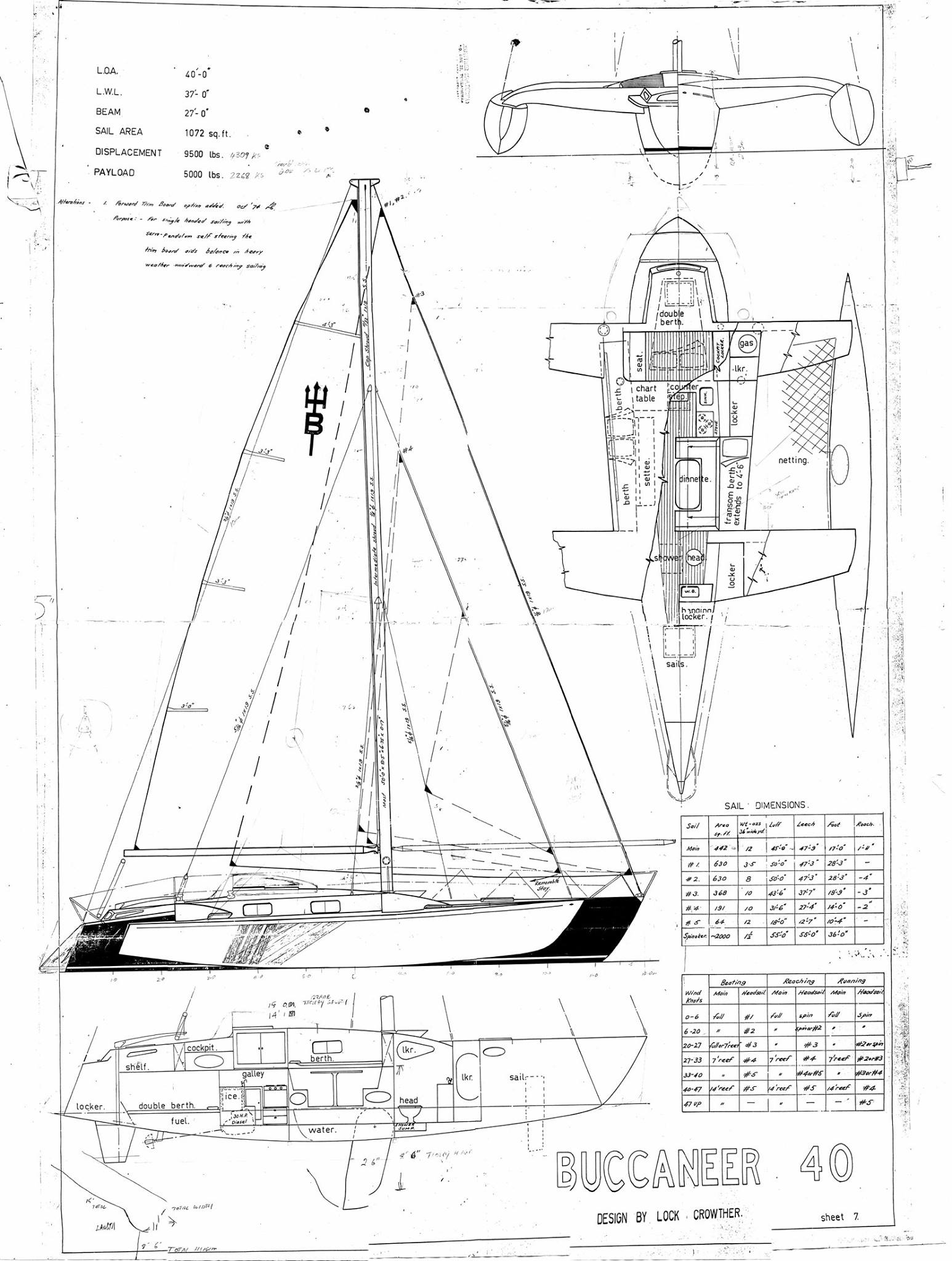
*Images are scrollable
Materials & Fabrication
Much of the rebuild required individual components to be repaired, modified or fabricated specifically for the vessel.
Composite construction techniques were combined with marine-grade timber and corrosion-resistant fittings, with work focused on structural strength, durability and practical access for future maintenance.
Rather than simply replacing existing components, the rebuild provided the opportunity to reconsider how systems and spaces worked together throughout the vessel.
- Composite structural repairs and reinforcement
- Marine-grade timber fabrication
- Structural beam and deck modifications
- Custom interior fit-out
- Reinforced structural junctions
- Corrosion-resistant fittings and hardware
Systems & Equipment Upgrade
Buccaneer 43’s onboard systems were extensively modernised during the rebuild to support independent cruising and extended passages.
Electrical, navigation, communication, plumbing and onboard utility systems were replaced or upgraded, with particular attention given to reliability, power management and ease of maintenance.
- Complete electrical system upgrade and rewiring
- Lithium battery storage
- Solar charging system
- Updated navigation and charting equipment
- AIS and VHF communications
- LED lighting throughout
- Freshwater system upgrades
- Bilge pump upgrades
- Gas hot water system
- Refrigeration
- Safety and monitoring systems
2018 | From New Zealand to Queensland
Completion of the rebuild marked the beginning of the next phase in Buccaneer 43’s story.
In 2018, the vessel left New Zealand and sailed across the Tasman to Queensland, putting three years of rebuilding work to the test in real offshore conditions.
After arriving in Australia, Buccaneer 43 continued cruising north along the Queensland coast.
This period provided something no workshop or design drawing could: the opportunity to live aboard, sail the vessel and learn how the rebuild performed in real-world conditions.
The experience gained during those years would eventually lead to the next major stage in the vessel’s development.
2022 | Keel Conversion & Further Refinements
After several years of sailing and cruising, Buccaneer 43 was hauled from the water in 2022 for a further stage of work.
The most significant modification was the removal of the original centreboard and construction of a fixed keel. The extended period ashore also provided the opportunity to undertake further maintenance, repairs and practical upgrades throughout the vessel.
Work completed during this period included improvements to the galley, resolution of previous engine issues and a range of maintenance and system upgrades before the vessel was relaunched in 2025.
2025 | Relaunched
Following completion of the keel conversion and subsequent work, Buccaneer 43 was relaunched in 2025.
The vessel returned to the water having undergone two distinct stages of development: the comprehensive rebuild completed in 2018, followed by further modifications and refinements informed by years of actual sailing and cruising experience.
Today, Buccaneer 43 represents the result of more than a decade of rebuilding, sailing, testing and continued improvement.
The Result
Buccaneer 43 was not rebuilt and simply left untested.
She was rebuilt from bare hulls, sailed across the Tasman, cruised along the Queensland coast, hauled out for further major modifications and returned to the water in her current configuration.
That history provides a documented progression from the original Crowther design, through the comprehensive rebuild, to the vessel offered for sale today.